
Under the Neon and Steel: The Hidden History and High-Tech Brains of Edmonton’s K-Days
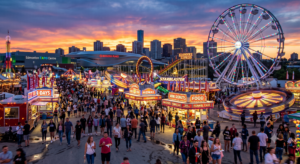
Every July, a familiar electricity hums over the Edmonton EXPO Centre. The smell of freshly fried mini donuts fills the air, neon lights paint the summer night, and the screams of thrill-seekers echo across the midway.
K-Days is Edmonton’s ultimate summer tradition. But behind the modern festival of massive concerts, extreme eats, and gravity-defying rides lies nearly 150 years of history—and a highly sophisticated web of hidden technology keeping the modern midway running safely and smoothly.
From Agriculture to Gold Rush: A Quick History
Long before the extreme rides of today, K-Days had much humbler beginnings.
1879: The Edmonton Exhibition begins at Fort Edmonton, showcasing livestock and grains.
  │
1910: The fair outgrows its original space and moves to its current home at Northlands.
  │
1962: The event is rebranded as "Klondike Days," embracing a 1890s Gold Rush theme.
  │
2006: A brief, unpopular rebrand to "Capital EX" takes place.
  │
2012: Back by popular demand, the name officially changes to "K-Days."
The Early Days (1879–1961)
It all started on October 15, 1879, when the Edmonton Agricultural Society hosted the very first Edmonton Exhibition on the grounds of Fort Edmonton. Attended by just 500 people, it wasn’t about roller coasters; it was a showcase of local livestock, grain, and handiwork.
By 1910, the fair moved to its current site (now the EXPO Centre) to accommodate soaring crowds. Throughout both World Wars, the fairgrounds served as military training bases, but the exhibitions kept on rolling.
The Gold Rush Era (1962–2011)
In 1962, organizers introduced a kitschy, colorful theme celebrating the 1890s Klondike Gold Rush—even though the actual gold rush occurred over a thousand miles away in the Yukon! Edmontonians fully leaned into the theme. People dressed in authentic 1890s finery (anyone caught on the promenade in modern clothes was thrown into a mock “K-Days jail”), watched bathtub races downtown, and cheered on ambassadors like the legendary “Klondike Kate.”
Following a brief and highly unpopular rebrand to “Capital Ex” in 2006, a public vote in 2012 brought back the letter “K,” officially cementing the name as K-Days.
How Technology Runs the Modern Midway
The creaky, purely mechanical rides of the mid-20th century are long gone. Today’s K-Days rides, operated by North American Midway Entertainment (NAME), are essentially giant, mobile, automated robots.
If you’ve ever wondered how a massive thrill ride like the Speed or the Crazy Mouse operates safely day after day, the answer lies in high-tech automation.
1. The “Brains” of the Ride: Safety PLCs
The unsung heroes of the midway are Programmable Logic Controllers (PLCs). These are rugged, industrial computers designed to withstand the harsh outdoor elements, vibrations, and extreme temperatures of a traveling fair.
Rather than relying on human operators to perfectly time brakes or speed, PLCs continuously monitor the ride.
- Lockstep Redundancy: High-thrill rides often use dual or triple PLC architectures. Two computers run the exact same program simultaneously. If their data outputs diverge by even a millisecond, the system automatically triggers a fail-safe stop.
- Fail-Safe Design: If a power failure occurs, the computer does not simply shut down; it cuts power to pneumatic hold-back valves, causing physical, spring-loaded brakes to clamp shut instantly.
2. Smart Sensors & Zone Management
Modern rides utilize hundreds of proximity sensors and limit switches. On roller coasters, these sensors divide the track into distinct “block zones.” The PLC will physically prevent a coaster train from leaving a station or climbing a hill if the sensors indicate that another car is still occupying the track ahead.
[Station Zone] ──(Coaster Train 1)──> [Sensor Check] ──(Locked Out)──> [Block Zone with Train 2]
3. VFDs (Variable Frequency Drives)
Have you ever noticed how modern rides start and stop with buttery smoothness? That is thanks to Variable Frequency Drives (VFDs). Instead of slamming a motor from 0 to 100% power (which causes immense mechanical stress and a jerky ride), VFDs electronically regulate the frequency of the electricity going to the motors, creating highly precise, repeatable speed ramps.
4. Advanced Light and Sound
The classic, buzzing incandescent lightbulbs of the past have been replaced by ultra-bright, energy-efficient LED light systems. These lights are completely programmable, allowing entire rides to change color palettes in sync with the music—all controlled by the ride’s central computerized show system.
Experience It Yourself
Whether you are going for the adrenaline rush of the rides, the live music, or simply to see the incredible robotics competitions hosted on-site, K-Days is a beautiful blend of Edmonton’s heritage and cutting-edge engineering.
The next time you are spinning upside down high above the EXPO Centre, take a second to appreciate the silent, split-second digital decisions keeping you perfectly safe!